


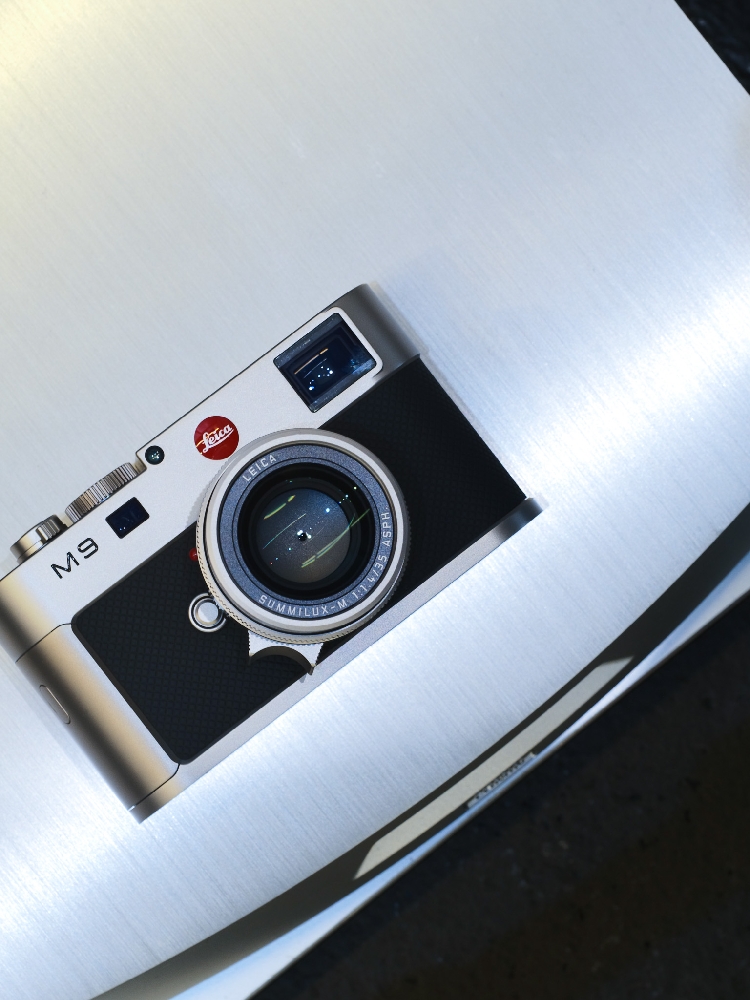
Of all the lenses Leitz has made, few carry as much freight as the first 35mm Summicron. It has a nickname in three languages, a price that has multiplied several times over in twenty years, and a reputation that arrived long before most of the people repeating it had ever put a roll through one.
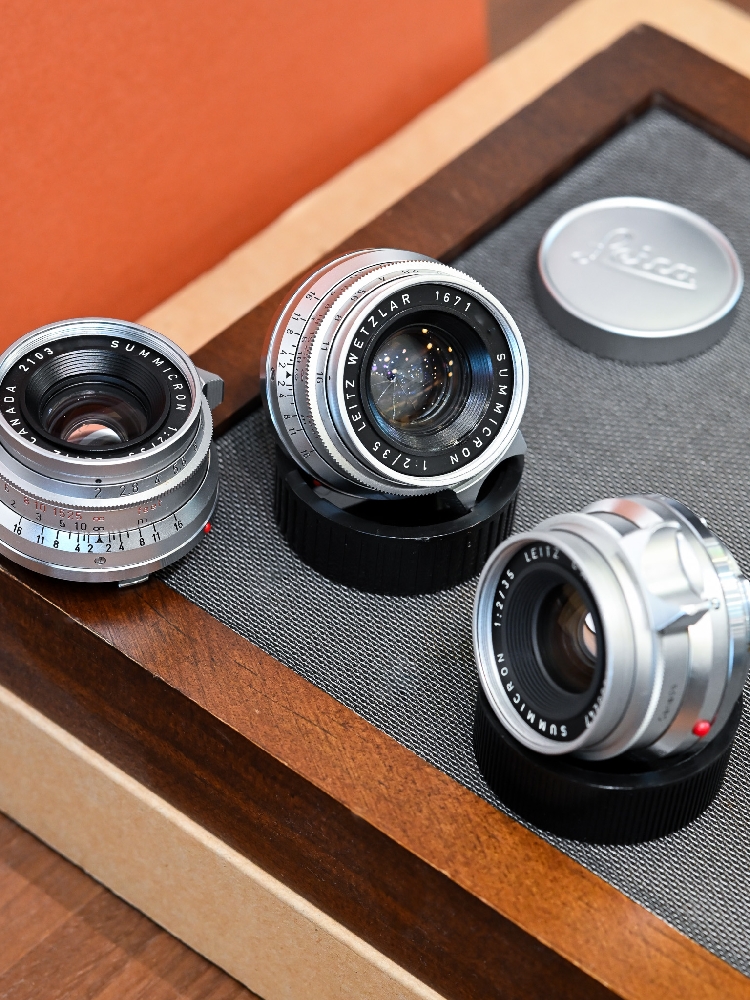
Some of that reputation is earned. Some of it is not. This is an attempt to separate the two — what the 8-element actually does with light, how it is put together, and what you should be looking at before you spend the money.
Eight elements in six groups
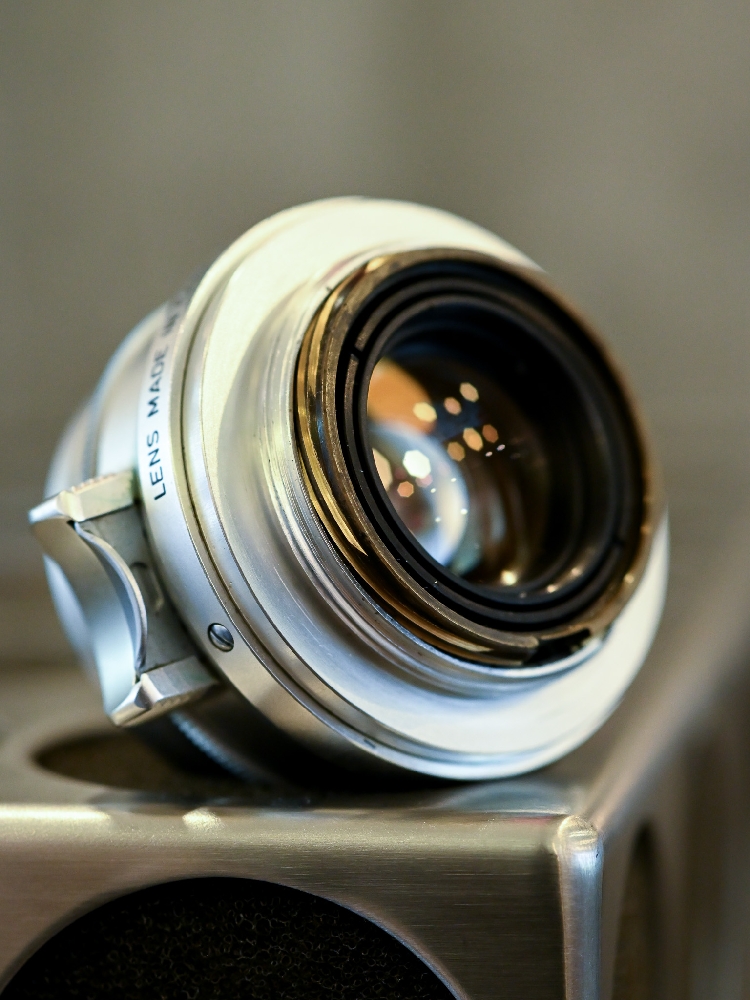
The first Summicron 35mm is the one collectors mean when they say the 8-element, or, in Japan, 8枚玉 — "8-glass". Eight elements in six groups, an augmented double-Gauss using rare-earth glass, drawn under Walter Mandler and built at both Wetzlar and Leitz Canada in Midland, Ontario, between 1958 and 1969.
It is an unusually complex prescription for a wide-angle lens of its era, and an expensive one: eight air-glass surfaces in 1958 meant eight opportunities for flare, at a time when coatings were single-layer. Leitz built it anyway. That decision is the reason the lens looks the way it does, and the reason it was replaced after eleven years by something simpler and cheaper to make.
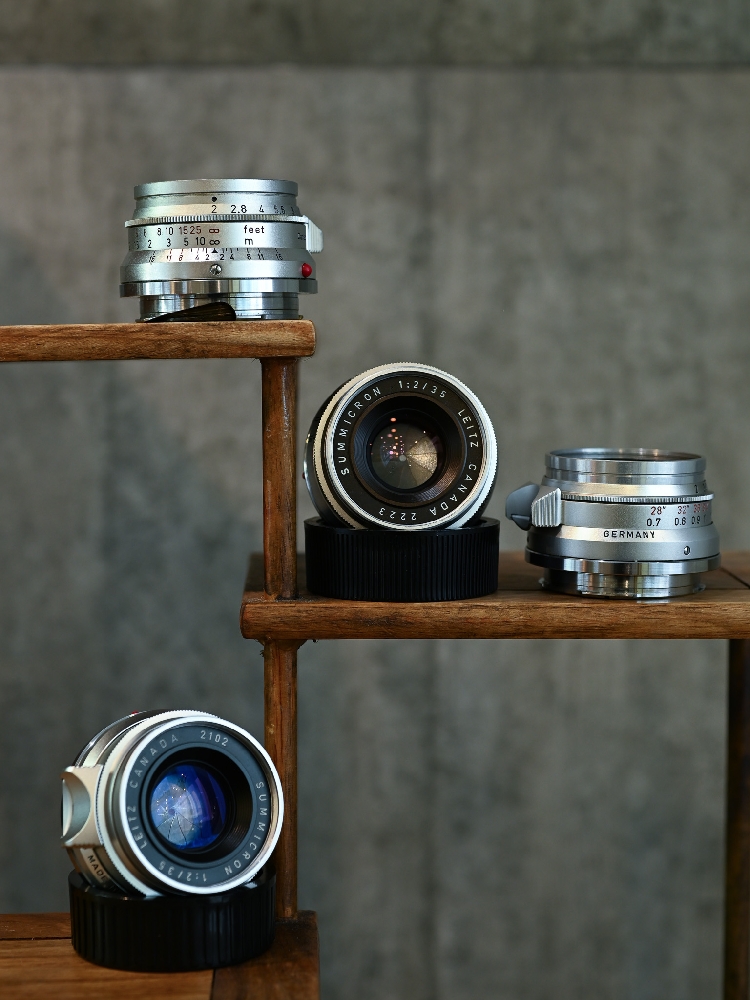
Roughly 21,500 were made in bayonet mount, plus a much rarer screw-mount run of about 577 pieces.
| Optical design | 8 elements in 6 groups, augmented double-Gauss, rare-earth glass |
| Years of production | 1958–1969 |
| Made | approx. 21,500 in bayonet mount, plus approx. 577 in screw mount |
| Factories | Leitz Wetzlar and Leitz Canada (Midland, Ontario) |
| Filter | E39 |
| Minimum focus | 0.7m — 0.65m on the goggled M3 version, 1m in screw mount |
| Superseded by | the 6-element Version 2, from 1969 |
The four configurations
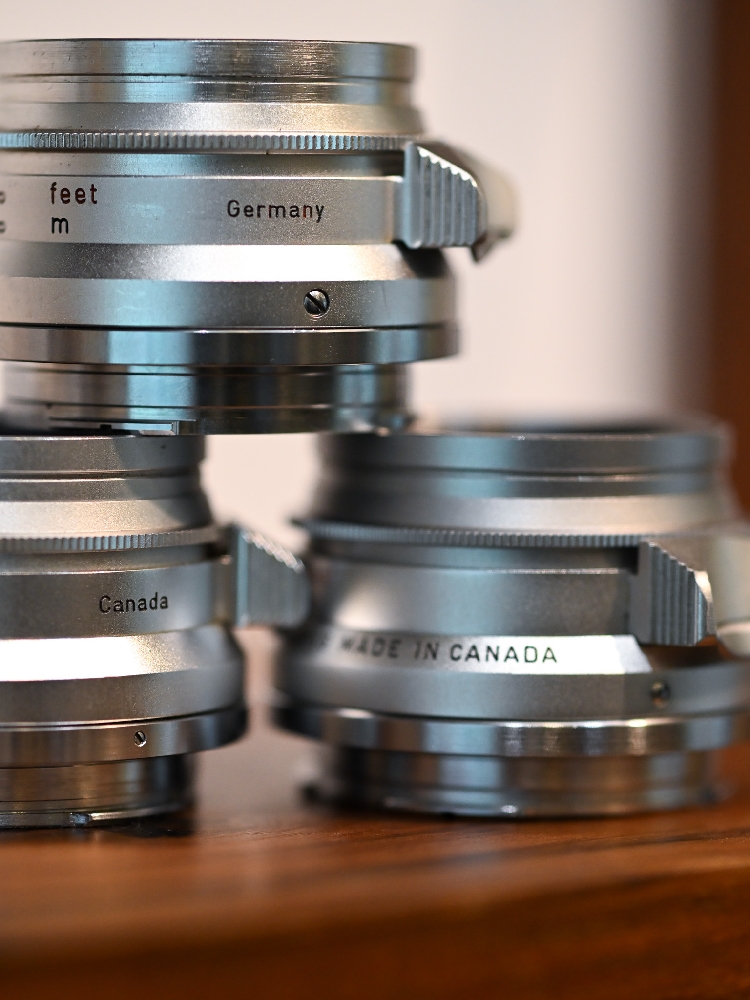
The engraving on the front ring tells you the factory. The order code tells you everything else.
| Order code | Finish & mount | Goggles | Notes |
|---|---|---|---|
| SAWOM / 11308 | Silver chrome, M bayonet | No | The standard lens. Fits M2 and every later M. |
| SAMWO / 11108 | Chrome or black paint, M bayonet | Yes | For the M3. About 9,557 built. Focuses to 0.65m. |
| 11307 | Black anodised, M bayonet | No | Considerably scarcer than the chrome. |
| SAWOO / 11008 | Screw mount (LTM) | No | Only about 577 made. The scarcest way to own the design. |
What it does on black and white
This is where the 8-element earns its reputation, and where a specification sheet is no help at all.
Measured against any modern lens, it is not sharp wide open and it is not high in contrast. Japanese reviewers say so bluntly — 高描写ではない, "it is not a high-resolution rendering"; one goes further and says むしろ写らない, "it rather fails to render". Both are true and neither is the point.
What the lens does instead is hold an enormous amount of information in the shadows while letting the highlights breathe. On film, the tonal transition from a lit cheek into shade is long and unbroken, with no sudden step where the midtones give up. One Japanese reviewer describes it as シャドウが潰れるのは早いが、実は潰れていなく奥の奥までしっかり描いていて恐怖すら覚える程 — "the shadows appear to crush early, but in fact they have not crushed at all; they are rendered right into the very depths, to the point of being almost frightening."
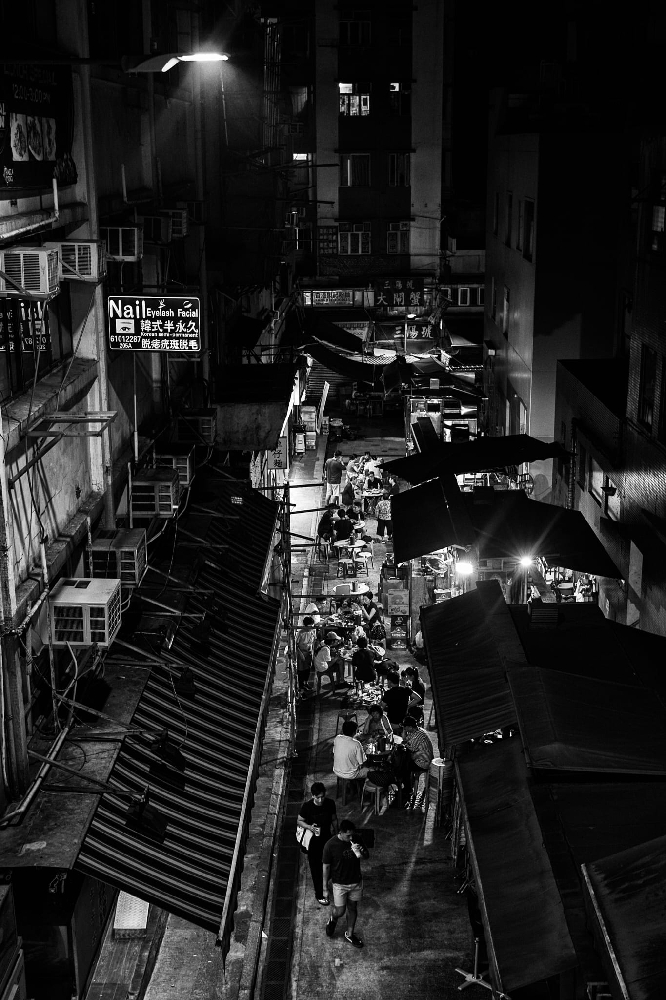
That is an accurate description of what a well-exposed Tri-X negative through this lens looks like under a loupe. The blacks are not empty. There is structure in them.
The same reviewer reaches for the word 妖気 — an untranslatable term meaning something like a bewitching or uncanny air — and talks about an impact close to that of a spirit photograph. Florid, but anyone who has printed a portrait from this lens knows what is being described. A repair specialist in Tokyo puts it more soberly: その高密度な描写, "that dense rendering", is why demand has never let up.
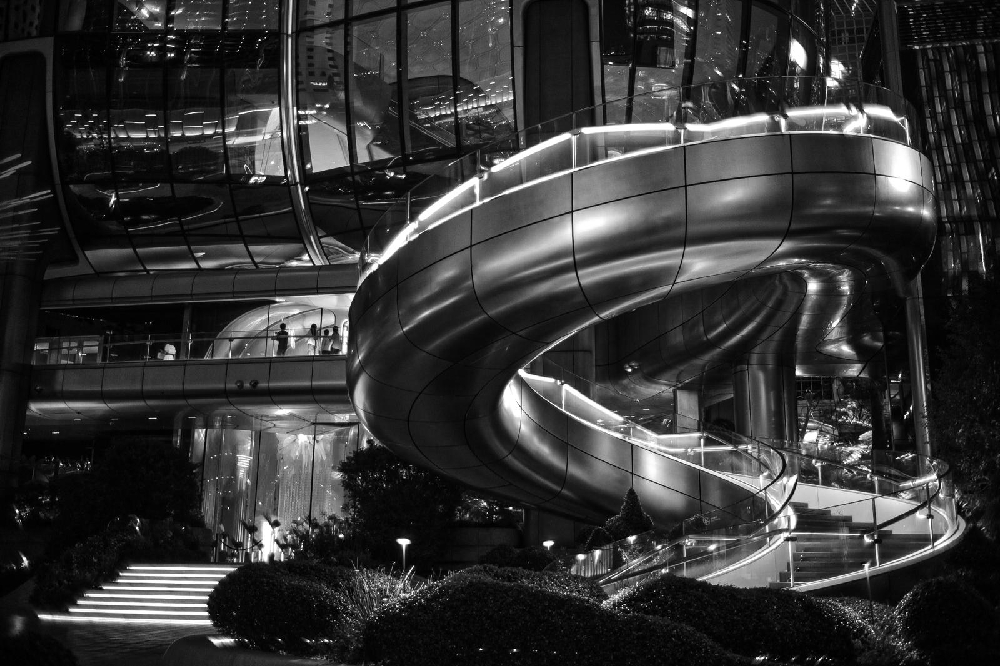
Stopped down to f/4 the lens sharpens considerably and the character recedes. Wide open, shot into the light, with a subject at two metres, it does something no 6- or 7-element Summicron does. It is a black-and-white portrait lens that happens to be a 35mm.
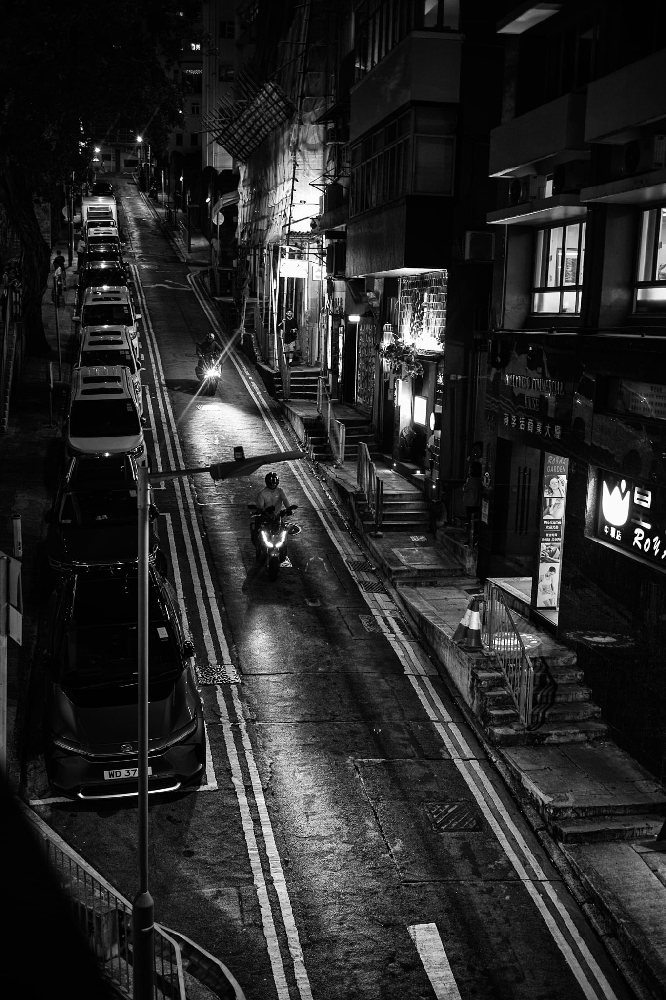
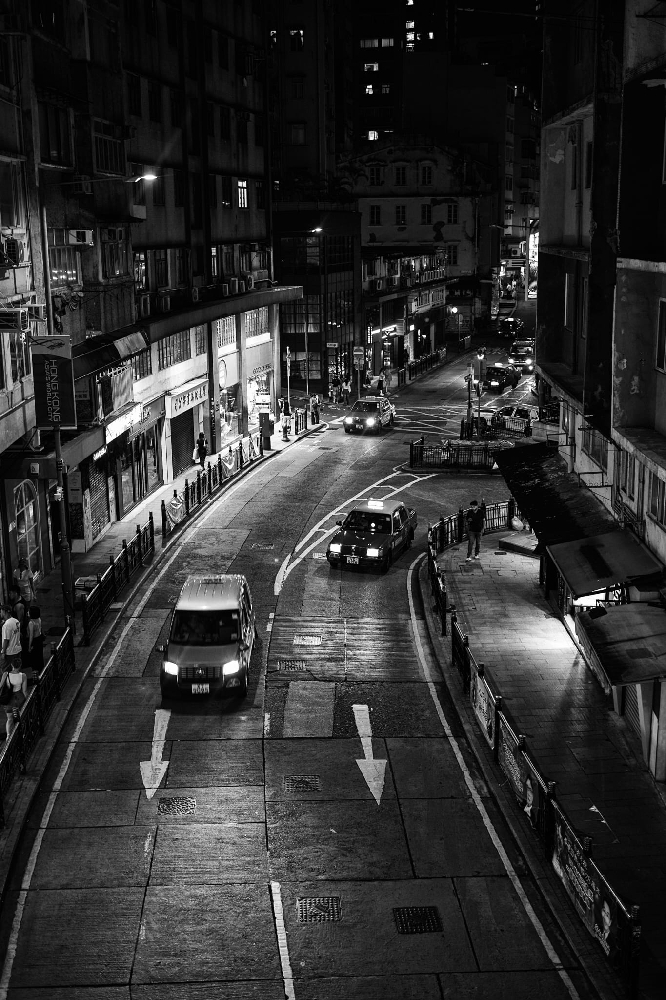
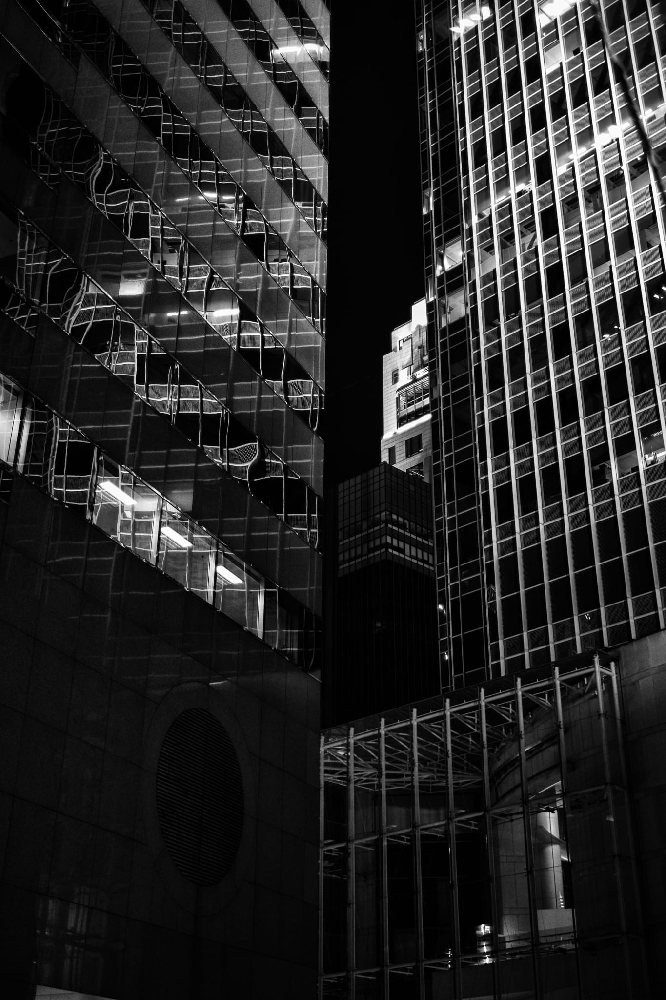
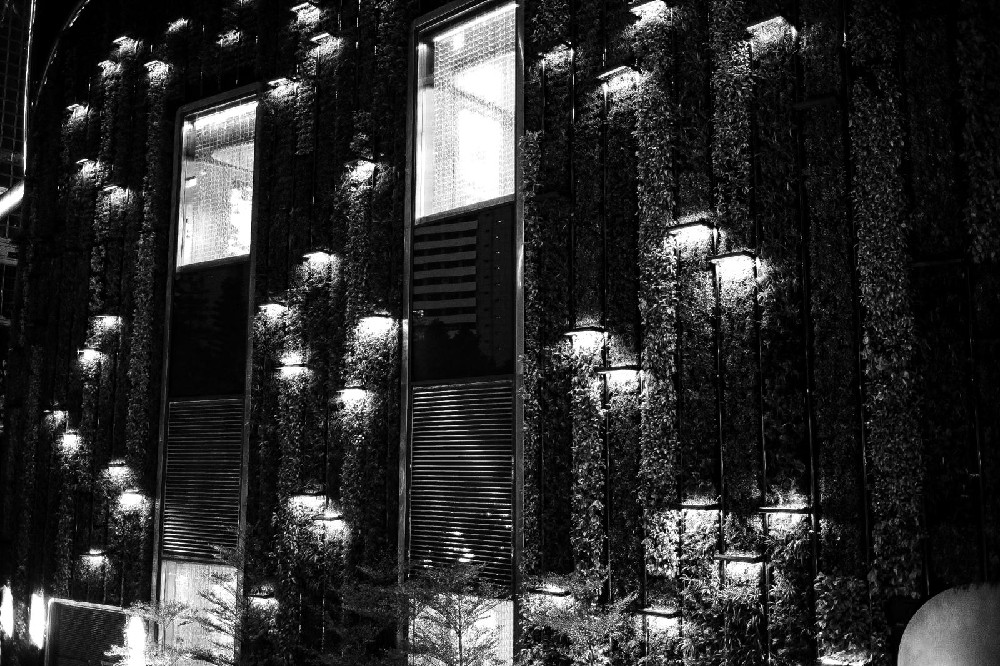
All frames above: Leica Summicron 35mm f/2 Ver.1, 8-element. Hong Kong, at night.
The way it is built
Pick one up next to a Version 4 and the difference is immediate. The 8-element is heavier than a lens this small has any right to be, and every control has a deliberate, damped weight to it.
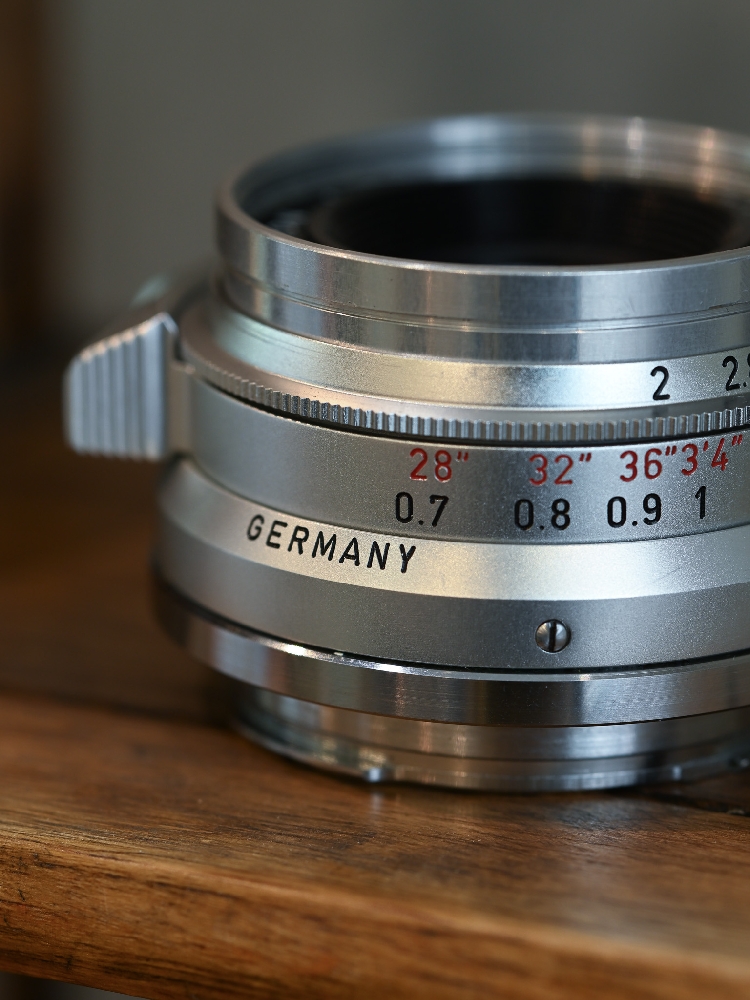
The focusing ring uses a fine ribbed knurl rather than the broad scallop of the later barrels, and it turns on a helicoid that a Tokyo repair shop specialising in classic Leitz equipment describes with unusual warmth: 細部にいたるまで造りがすばらしく、ヘリコイドの滑らかな動作や無限遠ストッパーの小気味よい作動感など感激ものです — "the construction is superb down to the smallest detail; the smooth action of the helicoid and the crisp feel of the infinity stop are genuinely moving."
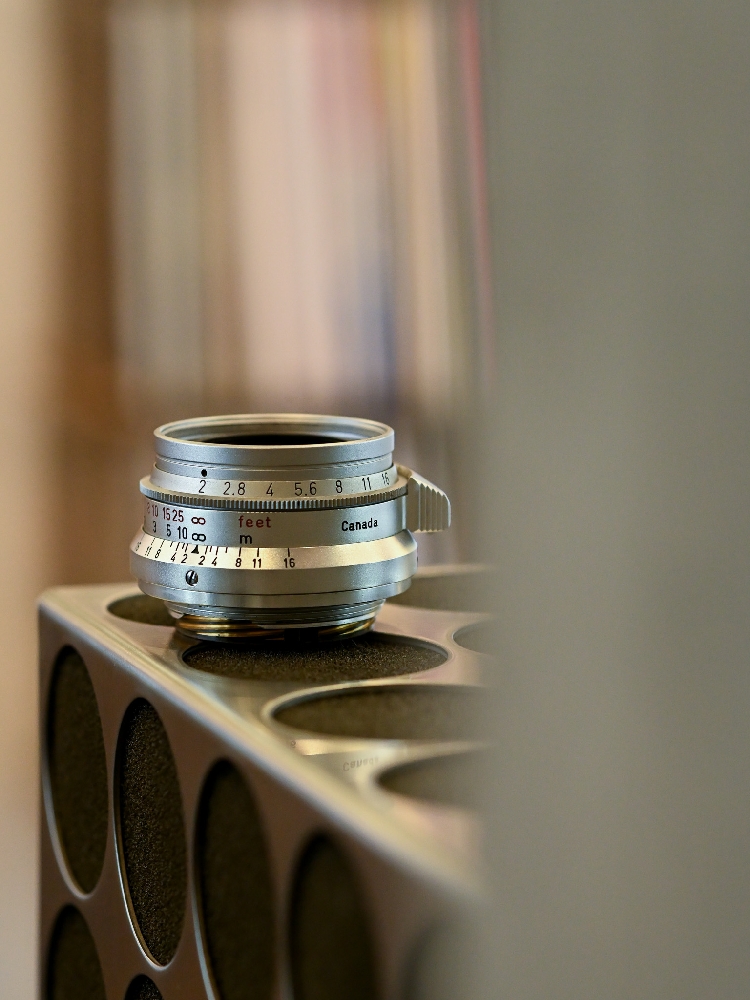
The infinity stop is worth singling out. It engages with a small positive click and releases under the thumb without hunting. Sixty-five years later it still works exactly as it should on a good example, which is the whole argument for buying Leitz from this period.
The goggles, and why they are not a defect
The M3 finder has no 35mm frame line, so Leitz supplied an optical adapter that reduces the finder magnification and brings the 35mm frame into view. About 9,557 of the 8-elements left the factory with them. They also drop minimum focus from 0.7m to 0.65m.
On an M3 they are essential. On any later body they are removable dead weight, which is why goggled examples usually trade below clean non-goggled ones — and why, if you actually own an M3, the goggled version is the value buy of the entire family.
An honest note on the price
Some of what the 8-element costs today is optics and craftsmanship. Some of it is not. Japanese commentators observe that the number eight is auspicious in Chinese numerology, and that this has fed demand from the Greater China market in a way that has nothing to do with how the lens draws. The same writers describe it as コスパが悪い — poor value for money — while continuing to recommend it.
Both things can be true. It is a wonderful lens and it is priced well above what its performance alone would justify. Buy it knowing that, and you will not be disappointed.
What to watch for
The Tokyo repair specialist quoted above adds a warning that deserves repeating: a worrying number of 8-elements look immaculate outside and perform poorly, because they have been apart at some point and reassembled by someone who should not have been in there. Element spacing in an 8-element design is unforgiving. Cosmetic condition tells you nothing about it.
| Check | How, and what it means |
|---|---|
| Separation | Shine a torch through at an angle. A coloured or oily patch creeping in from the edge of an element means a cemented group is delaminating. Not economically repairable — it belongs in the price. |
| Haze | Judge contrast against a bright window, not by eye alone. Light haze cleans. Haze that has etched an early single-layer coating does not. |
| Cleaning marks | The soft early coatings mark easily. Affects resale value far more than it affects photographs — but it does affect resale. |
| Previous surgery | The one you cannot see. Element spacing here is unforgiving, and a badly reassembled lens looks perfect. Only a test frame will tell you. |
| Goggles | On an M3 lens: optics clear, mount straight. Bent goggles throw the rangefinder coupling out. |
| Focus and aperture | Firm, even focus with no tight spot. Positive aperture clicks. No oil on the blades. |
More than with any other Summicron, buy from someone who has actually put film or a sensor behind the lens rather than just wiped the glass.
Is it the one to buy?
If you want a 35mm f/2 to work with, no. The 6-element Version 2 and Version 3 give you most of the vintage character for a working photographer's money, and the 7-element Version 4 gives you the famous out-of-focus rendering for a fraction of the price. We will come to both in a later post.
But if you shoot black and white, print your own work, and have understood everything above about what the 8-element does and does not do, then nothing else settles the matter. It is not the sensible choice. It was never meant to be.
We usually have several in stock — Wetzlar and Canadian production, goggled and non-goggled, chrome and black paint, and screw-mount examples when we can find them. If you would like to compare two side by side before deciding, come by the shop or message us and we will have them ready.